


Authentic Communication in An Age of Misinformation
 By Colbert Sivhada, CEO of Purple Square Media
We are living in an era where information travels faster than the truth.
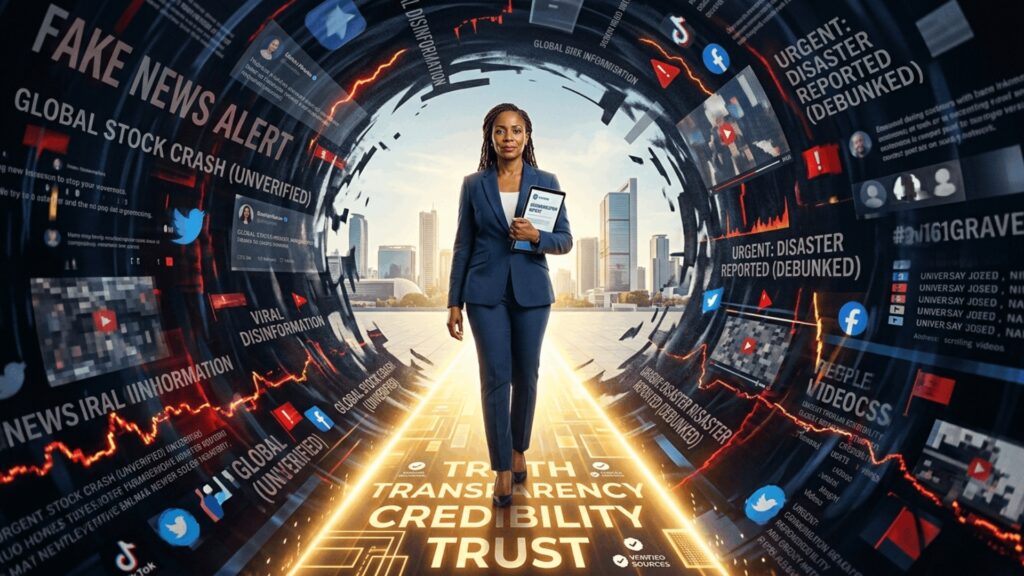
Every minute, millions of people scroll through headlines, clips, commentary, reposts, and algorithmically amplified opinions. In that flood of content, facts compete with fiction on equal footing. A fabricated quote can trend globally before a correction is even drafted. A manipulated video can shape public sentiment before anyone asks whether it is real.
For businesses, leaders, governments, and brands, this presents a defining challenge of our time: how do you communicate authentically in an age where trust is under constant attack?
The answer is not louder messaging. It is not a more polished branding. It is not even perfect public relations.
The answer is credibility.
Authentic communication begins with consistency between what an organisation says and what it actually does. Audiences today are remarkably sophisticated. They can identify corporate theatre from a distance. They know when language is performative, when values are borrowed for convenience, and when apologies are drafted merely to manage reputational damage.
ALSO READ: The Machine (AI) Can Write, but It Cannot Provide Meaning
In the past, organisations controlled the narrative through traditional media channels. Today, the public participates in building that narrative in real time. Employees, customers, communities, and even critics all contribute to shaping public perception. Trust can no longer be manufactured through advertising alone. It must be earned repeatedly through behaviour.
This is particularly important in Africa, where misinformation often intersects with political tensions, economic frustrations, and social inequality. False narratives spread quickly because they frequently tap into real anxieties. In such an environment, communication professionals have a responsibility that extends beyond protecting brand reputation. We have a responsibility to protect clarity, accountability, and public trust.
At Purple Square Media, we believe authentic communication is founded on three principles.
The first is transparency.
Transparency does not mean organisations must reveal every internal detail. It means communicating honestly, especially during moments of uncertainty or crisis. Too many institutions believe silence buys time. In reality, silence often creates space for speculation. When leaders avoid difficult conversations, misinformation immediately fills the vacuum.
People are more willing to forgive mistakes than deception.
The second principle is humanity.
Corporate communication has become excessively sanitised. Statements are often engineered to offend nobody and, in the process, say nothing meaningful at all. Authentic communication requires leaders to sound human again. People connect with sincerity, not templates. They respond to vulnerability, accountability, and empathy far more than jargon-filled press releases.
This does not mean abandoning professionalism. It means remembering that communication is ultimately about relationships, not just messaging.
The third principle is accountability.
In an age where misinformation spreads rapidly, credibility depends on whether organisations are willing to stand by their words. It is no longer enough to issue aspirational statements about ethics, inclusion, sustainability, or social impact. Audiences increasingly ask a simple question: “Can you prove it?”
Authenticity is measurable through action.
This is why leadership communication matters more than ever. Employees want transparency from executives. Consumers want honesty from brands. Communities want institutions that engage meaningfully rather than react defensively. The organisations that will thrive in the future are not necessarily those with the biggest budgets, but those with the strongest trust capital.
Technology has changed communication permanently, but it has not changed human instinct. People still recognise honesty. They still value integrity. They still gravitate toward voices they believe are genuine.
Ironically, in a world dominated by artificial amplification, authenticity has become a competitive advantage.
That means communicators must evolve beyond simply managing perception. We must become custodians of trust. This requires courage: the courage to correct misinformation quickly, the courage to admit mistakes publicly, and the courage to prioritise long-term credibility over short-term optics.
The age of misinformation is not going away. Artificial intelligence, deepfakes, manipulated content, and algorithm-driven outrage will continue to challenge how societies consume information. But amid that complexity, one principle remains unchanged: trust is built slowly and lost instantly.
Authentic communication is therefore not a marketing strategy but a leadership discipline.
And in the years ahead, it may become one of the most valuable assets any organisation possesses.
Related Post

Why Internal Communication Shapes External Reputation
Most organisations spend a great deal of time thinking about how they…

In An Age of Noise, Quality, Communication and Authenticity Provide…
We are living through the most information-dense moment in human history. Every…
